


Short Introduction to Jiangsu Local Culture: History, Nation, Diet, Architecture, etc.
Jiangsu, abbreviated as “Su,” takes its name from the first characters of Jiangning and Suzhou, two historic prefectures. Nanjing is the provincial capital. Located in eastern China, Jiangsu borders the Yellow Sea to the east, Shandong to the north, Anhui to the west, and Shanghai and Zhejiang to the southeast. The Yangtze River runs across the province from west to east, while the Beijing-Hangzhou Grand Canal runs from north to south. As of the end of 2025, Jiangsu had a permanent resident population of about 85.18 million.
Jiangsu is one of the birthplaces of ancient Chinese civilization and is rich in both natural and cultural attractions. Its landscapes range from the vast waters of Taihu Lake and Hongze Lake to the elegant scenery of Slender West Lake, the classical gardens of Suzhou, the Ming Xiaoling Mausoleum, and the Beijing-Hangzhou Grand Canal. The province is also renowned for its traditional crafts, including Suzhou embroidery, Nanjing Yunjin brocade, Yangzhou jade carving, and Yixing pottery, many of which are well known both in China and abroad.
Brief History
Jiangsu is one of the important cradles of ancient Chinese civilization, with a long history, diverse cultural traditions, and distinctive regional characteristics. The province is home to Wu, Jinling, and Huaiyang cultures, while also retaining historical influences from the Central Plains. It is also home to 13 National Historical and Cultural Cities.
Evidence of human activity in Jiangsu dates back as far as 350,000 years. During the Three Kingdoms period, the southern part of Jiangsu belonged to the Kingdom of Wu, while the area north of the Yangtze River was controlled by Wei. Later, the Eastern Wu, Eastern Jin, and the Southern Dynasties of Song, Qi, Liang, and Chen successively established their capitals in present-day Nanjing, making the city an important political and cultural center in southern China.
During the Sui and Tang dynasties, the opening of the Grand Canal turned Yangzhou into a major transportation and trading hub connecting northern and southern China. The city gradually developed into one of the most prosperous cities in China, attracting famous poets such as Li Bai and Du Mu, who left behind many celebrated poems inspired by Yangzhou. During the Song dynasties, Jiangsu became one of China's major grain-producing regions. Under the Yuan dynasty, the region was divided between the Jiangzhe and Henan Jiangbei provinces.
During the Ming dynasty, Jiangsu was incorporated into Nanzhili and came under the administration of the central Six Ministries. In 1667, the sixth year of the reign of the Kangxi Emperor of the Qing dynasty, Jiangsu was formally established as a province. Suzhou became an important economic and cultural center in Jiangnan thanks to its thriving silk industry and commerce, while its classical garden art reached its peak. Yangzhou flourished through the salt trade and Grand Canal commerce, giving rise to a distinctive salt merchant culture and garden tradition. Nanjing continued to develop as an important political, cultural, and commercial center.
In 1912, the Provisional Government of the Republic of China was established in Nanjing, with Sun Yat-sen serving as the provisional president. In 1937, Nanjing witnessed the Nanjing Massacre, one of the most tragic events in China's modern history. In January 1953, Jiangsu Province was formally reestablished, with Nanjing designated as its provincial capital.
Region Culture
Wu-Yue Culture
Wu-Yue culture, also known as Jiangsu-Zhejiang culture, is an important part of Chinese civilization and the distinctive regional culture of the Jiangnan area. Centered around the Taihu Lake basin, its historical influence extends across present-day southern Jiangsu, Zhejiang, Shanghai, southern Anhui, and northeastern Jiangxi. It can be broadly divided into Wu culture and Yue culture, which share common historical roots.
Wu Culture
Centered around Suzhou, Wuxi, and Changzhou, Wu culture is closely associated with the gentle and refined character of Jiangnan water towns. It can be seen in Suzhou’s classical gardens, Kunqu Opera, the soft Wu dialect, and the region’s preference for mildly sweet flavors.
Jinling Culture
Centered around Nanjing and Zhenjiang, Jinling culture reflects the heritage of Nanjing as the ancient capital of the Six Dynasties, combining the grandeur of an imperial capital with cultural influences from both northern and southern China. Nanjing Salted Duck, known for its savory and fresh flavor, is one of the best-known representatives of the region’s cuisine.
Huaiyang Culture
Centered around Yangzhou and Huai'an, Huaiyang culture flourished along the Grand Canal and has a rich cultural heritage. The region is also one of the main birthplaces of Huaiyang cuisine, known for dishes such as Lion’s Head Meatballs and Braised Shredded Dried Tofu.
Xuhan Culture
Centered around Xuzhou and Suqian, Xuhan culture reflects strong influences from the Central Plains and Qilu cultures. Known for its bold and vigorous character, the region is closely associated with the culture of the Han dynasty and is home to important Han-era historical sites. Local cuisine tends to favor savory and spicy flavors, with dishes such as Di Guo Chicken being popular specialties.
Coastal Culture
Along the coast, cities such as Lianyungang, Yancheng, and Nantong have developed distinctive coastal cultures shaped by their close relationship with the sea. These areas are characterized by an open and enterprising spirit, reflected in Lianyungang’s distinctive combination of mountains and sea and Nantong’s early modern industrial and educational development led by Zhang Jian.
Ethnic
Jiangsu is home to 55 ethnic groups. The Han Chinese account for approximately 99.27% of the province’s population, while the 54 ethnic minority groups make up about 0.73%. Among them, 13 ethnic groups have populations of more than 10,000, including the Mongolian, Hui, Tibetan, Uyghur, Miao, Yi, Zhuang, Bouyei, Korean, Manchu, Dong, Tujia, and Shui ethnic groups.
Local Dialect /Language
Jiangsu is divided into three major dialect areas: the Jianghuai Mandarin area, the Wu dialect area, and the Northern Mandarin area.
Architecture
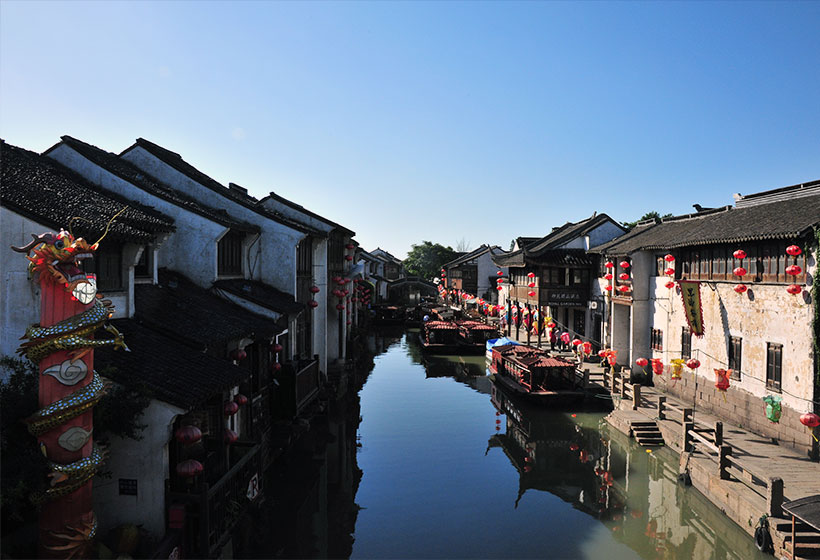
Southern Jiangsu: represented by Suzhou and Wuxi, is known for its classic Jiangnan water-town architecture. Traditional houses are often built along canals, creating the characteristic scene of homes lining the water. Many historic buildings combine commercial and residential spaces, with shops on the ground floor and living quarters above or behind them. Whitewashed walls, dark-tiled roofs, compact layouts, and gently sloping roofs designed to shed rain are typical features.
Suzhou-style architecture is particularly well represented by the city’s classical gardens, including the Humble Administrator’s Garden, Lingering Garden, and Master of the Nets Garden. These traditional residences and gardens often combine architecture, courtyards, ponds, rockeries, and plants into carefully designed spaces, creating a harmonious relationship between buildings and their surroundings.
Central Jiangsu: particularly the Lixiahe area, has its own distinctive architectural traditions. In places such as Xinghua, houses and villages have developed in response to the region’s waterways and wetlands. The famous Duotian landscapes are characterized by raised fields surrounded by water, with traditional houses built on or around these elevated areas. The architecture reflects a blend of southern and northern influences.
Northern Jiangsu: has traditionally been influenced more strongly by northern Chinese architectural traditions. In the plains, traditional homes commonly feature courtyard layouts, simple rectangular houses, and relatively regular building arrangements. Compared with the more intricate garden and water-town architecture of southern Jiangsu, northern Jiangsu architecture tends to emphasize practicality, spacious layouts, and sturdy construction, reflecting the region’s landscape and cultural heritage.
Traditional Festivals
Spring Festival (the first day of the Lunar New Year): The Spring Festival is one of the most important traditional holidays in Jiangsu. Families carry out thorough house cleanings, paste spring couplets on doorways, set off firecrackers, and visit relatives and friends to send New Year’s greetings—all to pray for peace, good fortune, and prosperity in the coming year.
Dragon Boat Festival (the fifth day of the fifth lunar month): The Dragon Boat Festival is another important traditional holiday in Jiangsu, typically celebrated by eating zongzi (sticky rice dumplings wrapped in bamboo leaves) and watching dragon boat races. It is also a time to honor the patriotic poet Qu Yuan and to ward off disease and evil spirits through traditional customs like hanging mugwort and wearing perfume pouches.
Special Festivals
Nanjing Qinhuai Lantern Festival: Dating back to the Six Dynasties, the Nanjing Qinhuai Lantern Festival, also known as the Jinling Lantern Festival, is one of the city’s most beloved traditional celebrations. Around the Lantern Festival on the 15th day of the first month of the lunar calendar, thousands of colorful lanterns light up the area around the Confucius Temple and Qinhuai River, creating a festive atmosphere in the heart of old Nanjing.
The festival features traditional lantern making, displays, lantern viewing, lantern boats, and various festive activities. Lotus lanterns and rabbit lanterns are among the most popular designs, symbolizing family reunion, happiness, and prosperity. The sight of thousands of lanterns illuminating the historic Qinhuai River creates the beautiful image of “lanterns lighting up every home and bringing families together.”
Welcoming the God of Wealth at Xuanmiao Temple (Lunar January 5th): Welcoming the God of Wealth is a cherished folk custom in Suzhou. Every year on the fifth day of the Lunar New Year, crowds of locals and tourists gather at Xuanmiao Temple to pray for a prosperous year ahead, hoping the God of Wealth will bless them with thriving businesses and abundant fortune.
Zha Shenxian (Treading the Immortals) – Lunar April 14th: Unique to Suzhou, "Zha Shenxian" is a traditional folk ritual held on the 14th day of the fourth lunar month. Locals flock to the Temple of the Immortals to seek blessings of good luck and "immortal energy." It’s a vibrant event that blends faith, culture, and a sense of communal hope for well-being and fortune.
Qintong Boat Festival: Held around the Qingming Festival in Taizhou, the Qintong Boat Festival is a national-level intangible cultural heritage tradition. More than a thousand boats gather on Qintong Lake for boat races and water performances, creating a spectacular traditional celebration. The festival also includes ceremonies honoring heroes who fought against the Jin dynasty during the Northern Song dynasty, as well as local customs such as inserting willow branches to pray for peace and good fortune.
Diet Style and Culinary Tastes
Jiangsu cuisine has great variety. After thousands of years of development. Jiangsu cuisine, also known as Su cuisine, is one of China’s Eight Great Culinary Traditions. Huaiyang cuisine is its best-known representative, while the broader tradition includes four major regional styles: Huaiyang, Jinling, Suzhou-Wuxi, and Xuhai cuisine. Known for its refined preparation, delicate knife skills, and fresh, balanced flavors, Jiangsu cuisine emphasizes the natural taste of its ingredients and elegant presentation. Popular specialties include Sweet and Sour Mandarin Fish, Yangzhou Fried Rice, Chinese mitten crabs, and Braised Lion’s Head Meatballs with Crab.
Cultural Heritage
Jiangsu is home to a rich collection of cultural and natural heritage. Its most famous sites include the Classical Gardens of Suzhou, represented by the Humble Administrator’s Garden, Lingering Garden, Master of the Nets Garden, Huanxiu Villa, Canglang Pavilion, Lion Grove Garden, Yipu Garden, Couple’s Retreat Garden, and Retreat & Reflection Garden; the Ming Xiaoling Mausoleum in Nanjing; the Grand Canal; and the Yancheng Coastal Wetlands, part of the Migratory Bird Sanctuaries along the Coast of the Yellow Sea-Bohai Gulf, a UNESCO World Natural Heritage Site.
Jiangsu is also renowned for its rich intangible cultural heritage. Among the most representative traditions are Jiangnan sizhu, a traditional form of Chinese chamber music; Kunqu Opera, often known as the “ancestor of a hundred operas”; the Xiangshan School of traditional architectural craftsmanship in Suzhou; Nanjing Yunjin brocade; traditional sericulture and silk craftsmanship; Yangzhou lacquerware; Yixing purple clay pottery; and traditional Chinese tea-making and tea ceremony. These traditions reflect the province’s long history of music, performing arts, craftsmanship, and everyday culture.
Jiangsu is also known for its rich Han-dynasty heritage and literary traditions. The province’s three celebrated Han cultural treasures include Han tombs, Han terracotta warriors and horses, and Han stone reliefs, particularly around Xuzhou. Jiangsu is also closely associated with three of China’s most famous classical novels, Water Margin, Journey to the West, and Dream of the Red Chamber. Together, these historical remains, traditional arts, crafts, and literary works form an important part of Jiangsu’s cultural heritage.
Customize Your Authentic Jiangsu Tour

If you are interested in the Jiangsu itineraries mentioned above, please contact us, and we will be happy to customize it and provide a quote tailored to your preferences.
Alternatively, if you would like to customize your Jiangsu Tour, please visit our Jiangsu Tour Customized Center. We assure you that you will receive a reply within 24 working hours.
Informative Articles for Your Jiangsu Trip
 Jiangsu
- Travel Guide: attractions, weather, hotels, food, etc.
- Weather: best time and seasons to visit Jiangsu
- Top attractions: well-selected top attractions in Jiangsu
- Local culture: brief history, folk culture, festivals, etc.
- Top destinations: best places to visit in Jiangsu
- Travel itineraries: itineraries for your reference
- Abundant activities: Jiangsu cultural immersions
- Unique perspective: top interesting things to do
- Local food: what to eat while traveling in Jiangsu
- Luxury hotels: accommodation to stay in Jiangsu
- Jiangsu Tours: customized tours for your reference

GREAT FAMILY CHINA TOUR
JULY 2024 We wanted to thank Grace at China Culture tour for organizing a great tour of China. We enjoyed our Beijing - Xian-Chengdu -Guilin -Yangshuo - Shanghai trip. Our local guides Bruce in Beijing, Susan in Xian, Jane in Chengdu, Mike in Guilin and Mary in Shanghai took care of us…read more details »
Teng Han L from SINGAPORE
Ready to Create a Unique Dream Travel?