

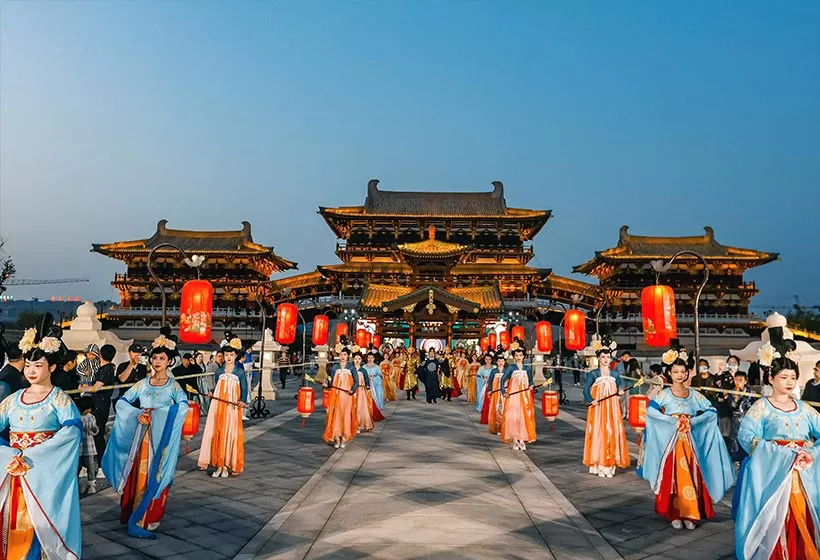
Top attractions, what you must visit in a Henan Trip
Top 1: Longmen Grottoes / Luoyang
As one of China’s Four Great Grottoes, the Longmen Grottoes represent the pinnacle of ancient Chinese stone-carving art. Over more than 400 years of continuous construction across several dynasties, more than 100,000 statues, 2,800 inscriptions, and 40 caves were created, making it the world’s largest and most richly adorned treasury of Buddhist sculpture—hailed as “the summit of Chinese stone art.”
The grottoes embody a breathtaking variety: some Buddha figures are as small as a fingernail, while the magnificent Vairocana Buddha towers 17.14 meters high. Each sculpture reveals delicate individuality—some wear a faint smile, others appear serene or contemplative.
Most of the carvings were commissioned by imperial families and nobility, making Longmen the only grotto complex in the world created under royal patronage. Among its most remarkable works are the Vairocana Buddha modeled after Empress Wu Zetian, the Guyang Cave created by Emperor Xiaowen for his grandmother, and statues commissioned by figures such as the grandson of Prince Lanling and Gao Lishi for Emperor Xuanzong.
Surrounded by picturesque mountains, the scenic area is dotted with major attractions including the Binyang Central Cave, West Hill and East Hill Grottoes, Xiangshan Temple, Guyang Cave, and Lianhua Cave—each a masterpiece that reveals the spiritual and artistic heights of ancient China.
- Address: on the Yi River bank, 15 kilometers from Luoyang downtown
- Open Hours: 8:00-18:00 (February - March, October 8 - October 31); 8:00-18:30 (April 1 - October 7); 8:00-17:00 (November - January)
- Tour Length: 2-3 hours
Top 2:Shaolin Temple / Zhengzhou
With a history spanning over a thousand years, Shaolin Temple embodies the perfect union of Zen and martial arts. Founded in 495 AD during the 19th year of the Taihe reign of the Northern Wei Dynasty, it is not only a place to witness the power and grace of Chinese kung fu but also to experience the serene charm of an ancient Buddhist monastery. In 2010, it was inscribed on the UNESCO World Cultural Heritage List.
Shaolin Temple, nestled deep within the forests of Mount Shaoshi—hence the name Shaolin, meaning “Temple in the Young Forest”—is the birthplace of Shaolin Kung Fu. During the Tang Dynasty, it became a prominent center of Buddhism under imperial patronage, and its martial arts gained wide recognition throughout the empire. Nearby, the Thousand Buddha Hall and the Martial Arts Training Pits showcase the profound integration of Buddhist practice and Shaolin martial arts. Today, Shaolin Kung Fu stands as one of China’s most renowned cultural symbols, with a legacy that stretches back more than 1,500 years.
The temple’s layout is symmetrically arranged along a central axis, rising with the mountain to create a solemn and dignified atmosphere. Key structures include the Mountain Gate, the Hall of Heavenly Kings, and the Mahavira Hall. The gate’s plaque was inscribed by Emperor Kangxi, featuring golden characters on a black background. Beyond the main halls, you’ll find some of Shaolin’s most remarkable sites. The Pagoda Forest, with 243 pagodas, forms the largest collection of monks’ stupas in China and is often hailed as a “Museum of Ancient Pagoda Art.” On Wuru Peak, the Bodhidharma Cave marks the legendary site where the monk Bodhidharma meditated in seclusion; inside, the “Shadow Rock” symbolizes the Chan (Zen) concept of sudden enlightenment. Together, these landmarks embody the profound spiritual and cultural legacy of the Shaolin Temple.
- Address: Songshan Mountain, Dengfeng, about 55km, 1.5 hours' drive from Luoyang
- Open Hours: 08:00-16:30
- Tour Length: 2-3 hours
Top 3: White Horse Temple / Luoyang
Built in AD 68, White Horse Temple is regarded as the cradle of Chinese Buddhism, preserving the “childhood memories” of Buddhism in China. It is also the only temple in the world that features architectural styles from China, India, Thailand, and Myanmar. According to legend, Emperor Ming of Han sent envoys to India to seek Buddhist scriptures, and they returned with two monks who carried the sacred texts on a white horse — giving the temple its name.
Inside the temple stands a grand bell cast in the Ming Dynasty, weighing over 5 tons. When it tolls at five o’clock in the morning, its resonant sound can be heard more than five kilometers away. The most remarkable sight is the Qiyun Pagoda, a 13-story brick pagoda with dense eaves that has stood for over 1,500 years. Though it leans slightly to the southeast, it has remained firm and upright through the centuries, earning the title of “The First Wonder Pagoda in Central China.”
Shaded by towering ancient trees and adorned with elegant, timeworn architecture, the temple also houses the Tomb of Di Renjie, the Relic Pagoda, Four-Faced Buddha, Great Buddha Hall, Museum, Bell and Drum Towers, and serene pavilions. The temple’s deep historical and spiritual atmosphere invites visitors to slow down, listen to the morning bell and evening drum, and feel the tranquil rhythm of Buddhist devotion.
- Address: Baimasi Town, Luolong District, 23 kilometers from Luoyang downtown
- Open Hours: 07:30-18:00
- Tour Length: 1-2 hours
Top 4: Taihang Grand Canyon Scenic Area / Anyang
Taihang Grand Canyon Scenic Area is located in Shibanyan Township, Linzhou, Anyang, in the heart of the southern Taihang Mountains of Henan Province. Formed by the erosion of the Lushui River, a tributary of the Zhuozhang River, the canyon stretches approximately 50 kilometers in length and 1.5 kilometers in width. Covering an area of 89 square kilometers, with elevations ranging from 800 to 1,739 meters and vertical drops exceeding 1,000 meters, it is often referred to as the "No.1 Canyon in North China."
The scenic area is divided into three main sections: Taohua Valley, Wangxiangyan, and Taihang Skyline Road. Towering peaks, layered mountains, winding streams, and mist-covered valleys create some of the most spectacular scenery in the Taihang Mountains.
Taohua Valley is especially renowned for its waterfalls and crystal-clear pools. A scenic 4-kilometer boardwalk connects highlights such as Huanglong Pool, Feilong Gorge, and the Nine-Tier Waterfalls. Other attractions include Taohua Waterfall, Taohua Cave, and the unique Taiji Ice Cave, where water, rock formations, and forest scenery blend harmoniously.
Wangxiangyan is known for its steep cliffs and breathtaking canyon views, while Taihang Skyline Road offers a series of panoramic viewpoints overlooking the vast mountain landscape. Visitors can also enjoy exciting attractions such as a glass viewing platform and an 88-meter-high spiral staircase suspended against the cliffs.
Combining magnificent natural scenery, unique geological formations, and a pleasant mountain climate, Taihang Grand Canyon is an ideal destination for sightseeing, hiking, photography, summer retreats, outdoor adventures, and nature appreciation.
- Address: Shiban'yan Township, Linzhou City, Anyang City, Henan Province
- Open Hours: 08:00—17:00
- Tour Length: 1-2 hours
Top 5: Yuntai Mountain / Zhengzhou
Yuntai Mountain is located about 1.5 hours by car from Zhengzhou and is renowned for its spectacular waterfalls, dramatic canyons, and striking Danxia landforms. Among its many natural wonders, the Yuntian Waterfall in Quanpu Gorge is the most famous, boasting a single-drop height of 314 meters. The scenic area includes several major attractions, such as Hongshi Gorge, Tanpu Gorge, Quanpu Gorge, Zhuyu Peak, Diecai Cave, Macaque Valley, Zifang Lake, and Wanshan Temple. Known for its abundant water scenery, unique canyon landscapes, and rich cultural heritage, Yuntai Mountain is one of northern China's most popular summer retreats. The average temperature within the valleys is around 23°C during summer, providing a cool and comfortable escape from the heat. In addition to its rich vegetation, the area is also an important habitat for a variety of wildlife species.
Yuntai Mountain has a long history dating back to the Xia and Shang dynasties. Over the centuries, numerous scholars and poets visited the area and left behind literary works inspired by its beauty. The influence of both Buddhism and Taoism can also be seen in the ancient temples and cultural relics scattered throughout the scenic area.
Beyond its natural and cultural attractions, visitors can enjoy exciting activities such as the Glass Skywalk and the Fenghuangling Cable Car. The scenic area also hosts a variety of seasonal cultural events, including temple fairs, folk festivals, dragon dances, and lion dance performances. Whether you are drawn to breathtaking natural scenery or fascinated by history and culture, Yuntai Mountain offers a memorable and rewarding travel experience.
- Address: Yuntaishan Town, Xiuwu County, Jiaozuo City, Henan Province
- Open Hours: 6:30-18:30 (Closed on Mondays)
- Tour Length: 1-2 days
Top 6: Luoyang Museum / Luoyang
The Luoyang Museum serves as a gateway to exploring the rich history and culture of this ancient capital. Its extensive collection spans thousands of years, featuring artifacts from the Xia, Shang, Zhou, Sui, Tang, Five Dynasties, Song, Yuan, Ming, and Qing periods. The museum houses six themed exhibitions, including the Heluo Civilization, Treasures of Luoyang, Tang Sancai Ceramics, Han and Tang Pottery Figurines, Imperial Artifacts, and Stone Carvings.
With more than 20,000 cultural relics, the museum vividly showcases the grandeur of Luoyang’s civilization. Visitors can admire exquisite bronze ritual vessels from the Xia, Shang, and Zhou dynasties, elegant Han and Tang pottery figurines, brilliant Tang Sancai ceramics, delicate jade artifacts, and finely crafted stone carvings. Among the highlights are the bronze jue with nipple patterns, the square ding with beast-face motifs, and a white jade cup—masterpieces that exemplify the artistry and sophistication of ancient China.
- Address: Nietai Road, Luolong District, Luoyang City, Henan Province
- Open Hours: 9:00-17:00 (Closed on Mondays)
- Tour Length: 1-3 hours
Top 7: Yinxu / Anyang
Yinxu, located in Anyang, Henan Province, was the last capital of the Shang Dynasty (c. 1600–1046 BC) and is the first ancient capital in Chinese history to be confirmed by both historical records and archaeological discoveries. It is also the largest, most extensively excavated, and longest-studied ancient capital site in China.
The site includes the Palace and Ancestral Temple Area, the Royal Tombs, the Hougang Site, and the Huanbei Shang City Site. Its distinctive urban layout provides valuable insight into the development of early cities in East Asia.
Yinxu is world-famous for the discovery of oracle bones, China's earliest known writing system, as well as a remarkable collection of bronze vessels, jade artifacts, and other cultural relics. The excavation of Yinxu and the decipherment of oracle bone inscriptions extended China's documented history by nearly a thousand years, making the site a milestone in the study of Chinese civilization and one of the most important archaeological discoveries in the world.
Today, Yinxu stands as a UNESCO World Heritage Site and offers visitors a fascinating journey into the origins of Chinese writing, statehood, and Bronze Age civilization.
Top 8: Guoliang Village / Xinxiang
Guoliang Village is located in Shayao Township, Huixian City, Xinxiang, in the heart of the Southern Taihang Mountains. Surrounded by towering cliffs and perched at an elevation of up to 1,700 meters, this remote mountain village is famous for its spectacular Cliffside Road, one of the most remarkable engineering feats in rural China.
The road, known as the Guoliang Tunnel, was carved directly into a sheer cliff by local villagers between 1972 and 1977. Measuring 1,250 meters long, 5 meters wide, and 4 meters high, the tunnel was excavated entirely by hand using hammers, steel drills, and extraordinary determination. More than 26,000 cubic meters of rock were removed during its construction. The tunnel's 35 cliffside windows, originally created for ventilation and lighting, now serve as dramatic viewing platforms overlooking the surrounding mountains and valleys. Because of its extraordinary construction, the road is often referred to as the "Ninth Wonder of the World."
One side of the tunnel is formed by the solid rock face of Wanxian Mountain, while the other overlooks a deep gorge, creating breathtaking scenery throughout the route.
Guoliang Village also features several notable attractions, including the Sky Ladder, Fort Tower, Bailong Cave, and mountain springs hidden behind the village. The Sky Ladder, located about 2 kilometers from the village committee office, is renowned for its steep ascent and offers magnificent panoramic views of the Wanxian Mountain Scenic Area. Combining historical stories, engineering achievements, dramatic geology, and traditional village life, Guoliang Village is one of the most unique destinations in the Taihang Mountains.- Address: Wanshan Scenic Area, Shayao Township, Huixian City, Xinxiang City, Henan Province
- Open Hours: 7:00-18:00
- Tour Length: 1-2 days
Top 9: Longtan Grand Canyon / Luoyang
Carved by nature over billions of years, the Longtan Grand Canyon is a masterpiece of time itself, famed for its deep ravines, cascading waterfalls, and dramatic red rock formations. The landscape features striking U-shaped valleys, potholes, and ripple stones, each revealing the Earth’s ancient secrets. The most awe-inspiring sight is the “Heavenly Stele” — a 50-meter-high collapsed rock face etched with parallel lines that record twelve distinct geological eras. Celebrated as the “Gallery of Yellow River Landscapes,” the canyon captivates visitors with its ever-changing beauty, where after rain, a rare optical illusion appears to make water seem as if it’s flowing uphill.
- Address: Longtangou Village, Shijing Town, Xin'an County, Luoyang City, Henan Province
- Open Hours: 07:30—17:00
- Tour Length: 2-3 hours
Top 10: Xiaolangdi Water Control Project / Luoyang
The Xiaolangdi Water Control Project is a large-scale multipurpose hydraulic engineering project on the main course of the Yellow River and one of China's most important water conservancy achievements. Many visitors are impressed by the sheer scale of the dam and its role in flood control, sediment management, water supply, and power generation.
The scenic area covers approximately 100 square kilometers and features a vast reservoir, wetlands, mountains, and panoramic views of the Yellow River. Today, the reservoir area is known for its tranquil waters and improved ecological environment, offering visitors a very different view of the Yellow River from its traditionally sediment-laden image.
Major attractions include the Xiaolangdi Reservoir, Yellow River Grand Viewpoint, Jiulong Mountain, and the Yellow River Wetlands. One of the most spectacular sights occurs during the annual water and sediment regulation operation, which typically takes place between June and July, when massive volumes of water are released through the dam's discharge tunnels. Powerful jets of water surge from the outlets, creating thunderous sounds, towering mist, and dramatic scenery. Under favorable weather conditions, visitors arriving in the morning may even witness beautiful rainbows forming above the spray.
- Address: Xiaolangdi Village, Xiaolangdi Town, Mengjin County, Luoyang City, Henan Province
- Open Hours: 08:00—17:00
- Tour Length: 1-4 hours
Top 11: Dingliwan Village /Xinyang
You may be surprised to find a village with distinctive Huizhou-style architecture in Henan. However, the architecture of Dingliwan is not a simple reproduction of traditional Huizhou design. Instead, it combines classic Huizhou elements with the characteristics of southern Henan architecture, creating a unique local style.
One of the village's most distinctive features can be seen in its traditional residences. Many old buildings have specially designed observation openings above their gates, which were built to guard against bandits during times of unrest. This practical defensive feature is rarely found in traditional Huizhou architecture and reflects the village's unique history.
Dingliwan has preserved an impressive collection of historic architecture, including 109 traditional residences with a total of 438 rooms and more than 260 ancient architectural relics. Many of these structures date back to the Ming and Qing dynasties. Ancient stone-paved lanes, white walls crowned with horse-head gables, and exquisitely carved wooden doors and windows create an atmosphere of timeless charm.
Strolling through the quiet alleys, visitors can experience the lifestyle of traditional clan settlements, enjoy local folk performances, and gain insight into the region's agricultural heritage and rural culture.
- Address: Dingliwan Village, Balifan Town, Xin County, Xinyang City, Henan Province
- Open Hours: All day
- Tour Length: 1-4 hours
Top 12: Mount Laojun / Luoyang
Mount Laojun, a renowned Taoist Mountain, rises 2,217 meters above sea level. At its summit, the magnificent Golden Peak is home to a breathtaking complex of Ming and Qing imperial-style buildings. Shrouded in mist and clouds, the golden temples like a celestial palace. During sunrise and sunset, the mountaintop glows with dazzling colors, earning Laojun the title of “The No. 1 Immortal Mountain in the World.”
The mountain features attractions such as Laozi Cultural Park, Dragon Chanting Spring, Central Peak Clouds, Autumn Maple Forest, and She Shen Cliff. Scattered across the mountain are ancient Taoist temples, including Taiqing Palace, Shifang Courtyard, Lingguan Hall, Lincu Hall, Shepherd’s Pen, Jiuku Hall, Scripture Pavilion, Guanyin Hall, Sanqing Hall, and Laojun Temple, where the spirit of Taoism permeates every stone and cloud.
On the southern slope lies a vast granite stone forest, where the rocks take on vivid and lifelike shapes. Known as the “Stone Forest of the North,” it is the world’s largest granite peak forest, showcasing nature’s grand artistry in its purest form.
Notes: Laojun Mountain currently does not admit foreign nationals (visitors without Chinese nationality). Visitors from Hong Kong, Macau, and Taiwan may purchase tickets and enter the scenic area with valid identification documents.
- Address: Chengdong District, Luanchuan County, Luoyang City
- Open Hours: 08:00—18:00
- Tour Length: 2-3 hours
Top 13: Millennium City Park / Kaifeng
Inspired by the world-famous Northern Song Dynasty painting Along the River During the Qingming Festival by Zhang Zeduan, Millennium City Park is one of Henan's most iconic cultural attractions. The park faithfully recreates the prosperous capital of Bianjing through traditional architecture, royal gardens, bustling streets, waterways, and lively marketplaces, offering visitors a vivid glimpse into life over 1,000 years ago.
One of the park's highlights is its immersive atmosphere. Throughout the day, performers dressed in Song Dynasty costumes bring history to life with traditional weddings, folk customs, street performances, and cultural shows. Visitors can also watch demonstrations of traditional crafts such as sugar painting, paper-cutting, and kite making. Renting a Song-style costume is a popular way to fully immerse yourself in the experience and feel as though you have stepped back into the Northern Song Dynasty.
- Address: No. 5, Longting West Road, Longting District, Kaifeng City, Henan Province
- Open Hours: 09:00-22:00
- Tour Length: 0.5-1 day
Customize Your Authentic Henan Tour
If you are interested in the Henan itineraries mentioned above, please contact us, and we will be happy to customize it and provide a quote tailored to your preferences.
Alternatively, if you would like to customize your Henan Tour, please visit our Henan Tour Customized Center. We assure you that you will receive a reply within 24 working hours.
Informative Articles for Your Henan Trip
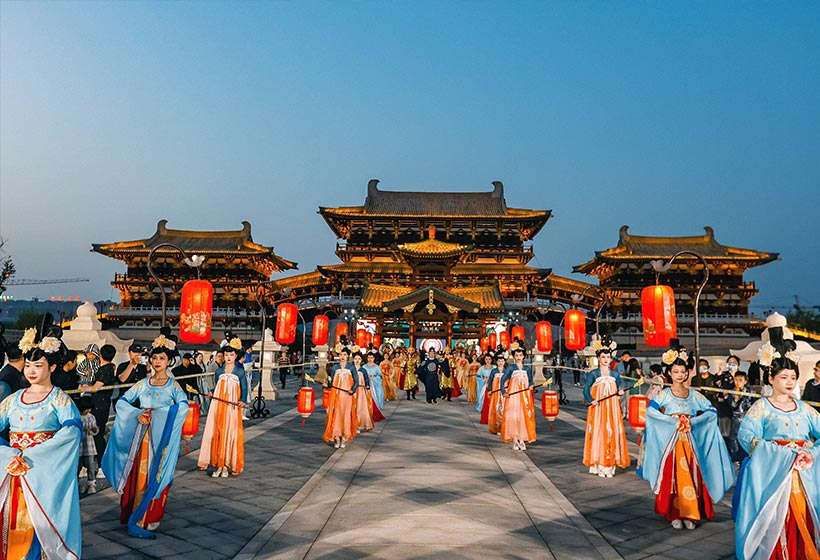 Henan
Henan- Travel Guide: attractions, weather, hotels, food, etc.
- Weather: best time and seasons to visit Henan
- Top attractions: well-selected top attractions in Henan
- Local culture: brief history, folk culture, festivals, etc.
- Top destinations: best places to visit in Henan
- Travel itineraries: itineraries for your reference
- Abundant activities: Henan cultural immersions
- Unique perspective: top interesting things to do
- Local food: what to eat while traveling in Henan
- Luxury hotels: accommodation to stay in Henan
- Henan Tours: customized tours for your reference

GREAT FAMILY CHINA TOUR
JULY 2024 We wanted to thank Grace at China Culture tour for organizing a great tour of China. We enjoyed our Beijing - Xian-Chengdu -Guilin -Yangshuo - Shanghai trip. Our local guides Bruce in Beijing, Susan in Xian, Jane in Chengdu, Mike in Guilin and Mary in Shanghai took care of us…read more details »
Teng Han L from SINGAPORE
Ready to Create a Unique Dream Travel?