

Short Introduction to Hong Kong Local Culture: History, Nation, Diet, Region Culture, etc.
The “xiang” (fragrant) in Hong Kong’s name comes from “guanxiang” (agarwood), and the “gang” refers to a harbor, meaning “Fragrant Harbor.” This name has been used ever since. Hong Kong is more internationalized than other first-tier cities such as Shanghai and Guangzhou. Its advantages lie in its convenient business environment, free trade, and efficient flow of information.
As a top global center for finance, trade, and shipping, Hong Kong is often grouped with New York and London as one of the “New York–London–Hong Kong” trio and ranks as the world’s third-largest financial center. It is also well known for its fusion of Eastern and Western cultures, earning the nickname “Pearl of the Orient.”
Famous attractions such as Victoria Harbour, Victoria Peak, Hong Kong Disneyland, and Tian Tan Buddha attract countless visitors.
Brief History
Hong Kong, like Macau, was once a colony. From 1840 to 1997, during this period, Hong Kong transformed from a small fishing village into an international financial center. It was influenced by Western systems and culture, while also retaining Chinese traditions, becoming a unique place where Eastern and Western cultures converged. In 1997, China resumed sovereignty over Hong Kong under the "One Country, Two Systems" principle.
Archaeological discoveries, such as the Da Wan site on Lamma Island, dating back around 6,000 years, have revealed artifacts like painted pottery and jade, proving that significant human activity had already occurred at that time.
During the pre-Qin period, Hong Kong belonged to the southern coastal area of the ancient Yue tribes, collectively known as Baiyue. Hong Kong was part of this region. After Emperor Qin Shi Huang unified China, he established the Nanhai Commandery in 214 BC, and Hong Kong officially became part of China's territory.
In the Sui Dynasty, the jurisdiction was merged into the Guangzhou Prefecture of the Nanhai Commandery, and Bao'an County was also placed under the Nanhai Commandery, with Hong Kong still under Bao'an County's administration. In the Tang Dynasty, during the second year of the reign of Emperor Dezong (757 AD), Bao'an County was renamed Dongguan County, and Hong Kong fell under its jurisdiction.
During the Qing Dynasty, Hong Kong was under the administration of Xinan County in Guangdong Province (present-day Shenzhen).
In 1840, British colonialists launched the Opium War against China. After the Qing government was defeated, Hong Kong was gradually ceded to Britain through several treaties and became a British colony. The British positioned Hong Kong as a trade port in the Far East, making it a hub for Sino-Western trade. Hong Kong's economy focused primarily on entrepot trade.
During World War II, Hong Kong was occupied by Japan for three years. After the war, many refugees and capital from mainland China entered Hong Kong, providing ample labor and funding for the city’s development. From the 1950s to the 1970s, Hong Kong's industry grew rapidly, especially in textiles, garment manufacturing, and electronics, making it one of the "Four Asian Tigers."
In 1997, China resumed sovereignty over Hong Kong, implementing "One Country, Two Systems." Hong Kong retained its capitalist system, legal framework, and way of life for 50 years, with the central government overseeing foreign affairs and defense.
Today, Hong Kong is fully integrated into China. With the support of China, it continues to maintain its status as an international financial center, shipping hub, and trade center, serving as a bridge between China and the rest of the world.
Region Culture
The Introduction of Customs
It is cultural etiquette for people to knock on the table with their fingertips to show gratitude. There is a custom where people in Hong Kong go to tea houses in the morning and drink soup to begin their day. At a banquet, the guests can start their meal only after the host says “pick up chopsticks.” During the meal, hands cannot be separated with chopsticks or put on the table, and chopsticks should be held horizontally. People should not pick up dishes away or pick up plates and turn the fish. There should be no sound made when drinking soup and no remnant of food should be left when finishing.
The Custom of Cutting off Chicken's Head
It was also called “burning yellow paper” which turned into a derogatory phrase for young people. At the beginning of the ceremony, two parties would kneel down before the statue of Buddha and light the candle, and worship the Buddha. Then, both of them would hold a piece of yellow paper written with a sworn oath and chant the oath aloud saying, “telling the truth, without empty talks”, “any casual remarks would lead to someone dying painfully and without descendants” and many others. After that, the deacon in the temple would take out the prepared kitchen knife, cutting board, and chicken, cutting off the chicken’s head to splatter the blood on the yellow paper and burn the paper shortly after.
This custom originated many decades ago. Later, however, when the court was unable to collect evidence in dealing with some cases, knowing people’s psychology, the court adopted this method to judge doubtful cases. Sometimes, this method is successful. In 1918, there were two merchants that engaged in a lawsuit due to debt, but both of them could not provide strong evidence. After many times of meditation, the court had no alternatives but to go to Man Mo Temple, cut a chicken’s head off, and later speak with a private adviser and lawyer. After arriving at the temple, if the plaintiff was unwilling to kneel and swear, it would let the judge know that the plaintiff was guilty. Thus, the judge would convict based on observations and this method. Although this form of adjudication has been recorded in history, this custom is rarely seen in courts today.
Fire-dragon Dance
The Fire-dragon dance is a custom with rich traditional elements. Starting from the evening of Lunar August 14th each year in the Tai Hang area in Causeway Bay. There, they conduct grand fire-dragon dances for three nights. This fire dragon is over 70 meters long and is composed of 32 sections of pearl grasses and longevity grass. At this distinguished gathering, with lighting and drum music, those fire dragons wind their way along streets and blocks of this district, presenting a tumultuous scene.
The origin of the Hong Kong fire-dragon dance has another legend. In early times, a wind disaster in Tai Hang brought a python that did all kinds of evil to people there. Finally, it was shot dead. Unexpectedly, the python disappeared without any trace the next day. Several days later, a plague swept Tai Hang. At that time, Buhhda appeared in the citizen's dream and made a request that only with the fire-dragon dance, can the plague be expelled. To the people’s surprise, it worked. Since then, the fire-dragon dance has spread up to now.
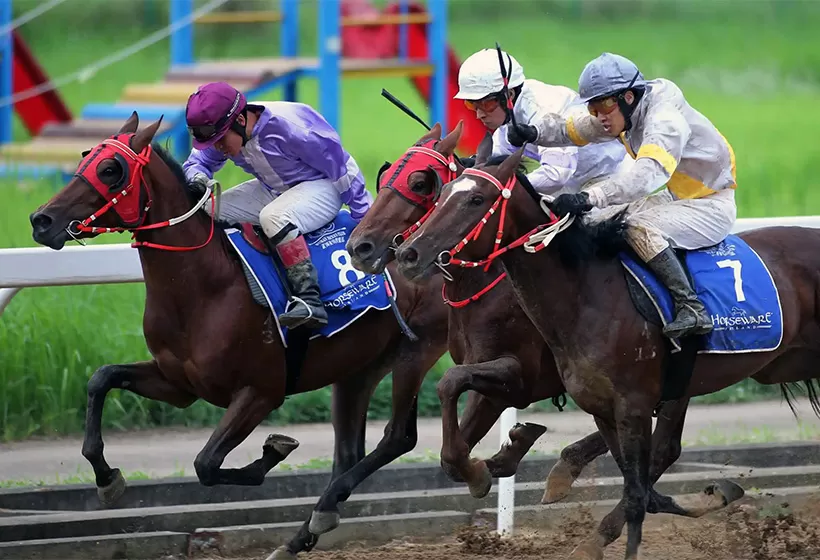
Hong Kong people enjoy watching horse racing. As the derby is a non-profit institution many benefit from charity, group education, and environmental protection. There are many recreational activities to do in Hong Kong including playing mah-jong, handbookinger, and mark-six lottery among others, of which playing mah-jong is the most common form of entertainment in daily life and social occasions.
In Hong Kong this metropolis does not exist, instead, its hustle and bustle are comparable with a well-known international metropolis. The cultural center of Hong Kong has 2,085 seats, equipped with the biggest motor pipe organ in southeast Asia. “100 Po Labyrinth” is the largest maze in Asia and the second largest in the world. Regal nightclub in Tsim Sha Tsui East is the world’s largest Japanese-style nightclub. Tourists also enjoy bringing their friends to sing karaoke on KTV. In Hong Kong, there are hundreds of KTV lounges. In hotels, you can find discotheques playing the most popular disc pieces of music or videotapes that utilize advanced acoustics and lighting. Generally, business hours are from 10:00 pm to 12:00 pm.
Population and Language
The population of the Hong Kong Special Administrative Region is approximately 7.53 million, with the majority being of Chinese descent. It is one of the cities with the highest population density in the world.
Hong Kong practices “liang wen san yu” (two written languages and three spoken languages), meaning both Chinese and English are official languages. The spoken languages include Putonghua (Mandarin), Cantonese, and English. Both Chinese and English are the official languages of Hong Kong.
Social Customs
The general characteristics of social customs in Hong Kong people can be summed up as cherishing friendship, being friendly, and attaching importance to etiquette.” Hong Kong people traditionally prefer auspicious things. Those whose hometowns are in china, particularly Guangdong and Fujian Province, still follow the customs of their ancestors even though they live in Hong Kong.
Etiquette
When Hong Kong people meet others they shake hands to show politeness to each other. When they meet friends, people give hugs and rub their cheeks sometimes. When they express appreciation, they curve their finger and use their fingertip to knock on the table. It is said that this etiquette evolved from kowtow. In fact, both of them share the same meaning in Hong Kong.
When you pour a glass of wine or tea to another, the recipient uses their fingertips to slightly knock the table. "3" is a very popular number in Hong Kong, as well as "8" and "6" as the pronunciation of "three" is a homophone of "Shen" ("shen" means to be promoted to a higher position or rank). "8", the homophone of "fa", means making a fortune, and "6" the homophone of "lu", means easygoing. During the festivals, it is a tradition to give others blessings.
Beliefs and Taboos
Inquiring about people's family addresses in Hong Kong is taboo. People prefer to invite guests to tea houses and public places instead of their own homes. Inquiring about one's wages, income, and age of others is also considered taboo because this information is private. "Happy holidays" is not accepted in Hong Kong as its pronunciation is a homophone of "falling fast" which is extremely unlucky. Moreover, "4" is the homophone of "die" which people try to avoid saying. If you are in an unavoidable case, people often use numbers to replace the number "4". In restaurants, ordering fried rice from the S menu is regarded as a taboo as "fry" is the homophone of "dismiss".
Diet Style and Culinary Tastes
Hong Kong cuisine is rooted in Cantonese traditions, enriched by a blend of Eastern and Western influences, and known for its emphasis on freshness, tenderness, and light flavors. From humble street food stalls to Michelin-starred restaurants, the city offers a diverse and dynamic dining scene. More than just a culinary experience, Hong Kong’s food culture reflects its history, migration, trade, and cultural fusion—preserving the essence of Cantonese cuisine while embracing global inspirations, making it one of the world’s most concentrated food capitals.
Signature dishes: Typhoon Shelter Crab, Roast Goose, Mock Shark Fin Soup.
Roast meats (Siu Mei): Including Sham Tseng–style roast goose, honey-glazed char siu, and crispy roast pork. These dishes are known for their crispy skin and tender meat, often roasted over fruitwood charcoal and served with plum sauce to balance the richness.
Dim Sum and Yum Cha: Represented by four signature specialties—shrimp dumplings, siu mai, char siu buns, and egg tarts—these delicacies feature delicate wrappers, generous fillings, and fresh, silky flavors.
Street food: Popular snacks include curry fish balls, egg waffles, stuffed three treasures, and cart noodles, offering a taste of Hong Kong’s vibrant street food culture.
Cultural Heritage
Hong Kong has transformed from a small fishing village into one of the world’s most vibrant and dynamic cities. This remarkable evolution is not only the result of the hard work of its people, but also the accumulation and continuation of its rich local culture. Over more than a century of development, the city has preserved numerous historical sites, while inheriting the essence of Lingnan culture and creating many distinctive cultural traditions of its own.
Historical heritage includes landmarks such as Tai Kwun (the former Central Police Station), 1881 Heritage, and the Big Wave Bay Rock Carving on Hong Kong Island.
Intangible cultural heritage is equally rich and diverse. Traditional practices include the art of guqin making, a refined craft of constructing the classical Chinese instrument, which was inscribed on the national intangible cultural heritage list in 2014. Other notable traditions include the Hakka Qilin Dance in Sai Kung, the belief system associated with Wong Tai Sin Temple, the Tai Hang Fire Dragon Dance, the Tai O Dragon Boat Water Parade, the Cheung Chau Bun Festival, the Yulan Festival, the “villain-hitting” ritual, and the herbal tea culture of Hong Kong.
Together, these tangible and intangible heritages form a vivid reflection of Hong Kong’s cultural identity, where tradition and modernity coexist in harmony.
Customize Your Authentic Hong Kong Tour

If you are interested in the Hong Kong itineraries mentioned above, please contact us, and we will be happy to customize it and provide a quote tailored to your preferences.
Alternatively, if you would like to customize your Hong Kong Tour, please visit our Hong Kong Tour Customized Center. We assure you that you will receive a reply within 24 working hours.
You might also like the following helpful information about Hong Kong
 Victoria Harbour
- When is the best time or season to visit Hong Kong
- Top attractions you might like in Hong Kong
- Choose your food and restaurants while traveling in Hong Kong
- Do not know where to stay? Visit the best hotels in Hong Kong
- To know more about Hong Kong, visit its culture
- Travel itineraries: itineraries for your reference
- Abundant activities: Hong Kong cultural immersions
- Unique perspective: top interesting things to do
- Top destinations: best places to visit in Hong Kong
- What to buy and where to shop in Hong Kong?
- Enjoy an interesting and colorful nightlife
- Bank and currency, help you save money

GREAT FAMILY CHINA TOUR
JULY 2024 We wanted to thank Grace at China Culture tour for organizing a great tour of China. We enjoyed our Beijing - Xian-Chengdu -Guilin -Yangshuo - Shanghai trip. Our local guides Bruce in Beijing, Susan in Xian, Jane in Chengdu, Mike in Guilin and Mary in Shanghai took care of us…read more details »
Teng Han L from SINGAPORE
Ready to Create a Unique Dream Travel?