

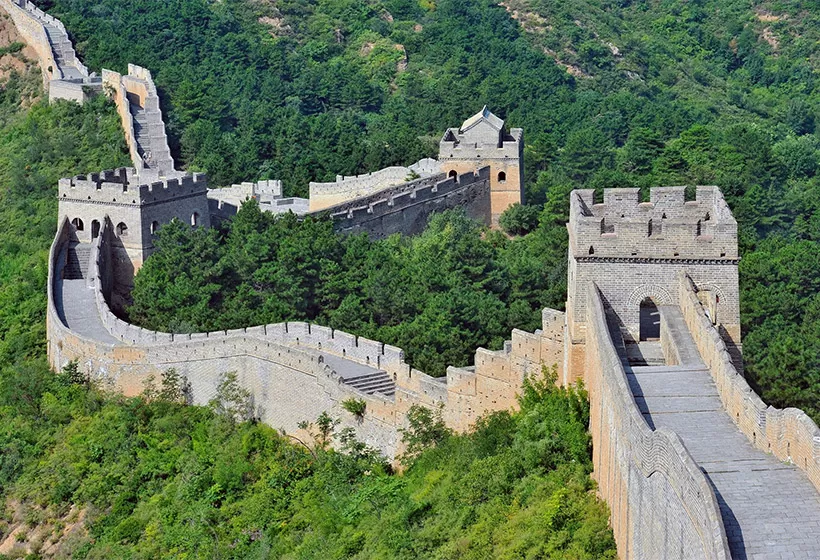
Great Wall of China
World Cultural Heritage Site: The Great Wall Beijing (1987)
In 220 BC, under Qin Shi Huang, the first emperor of China, sections of earlier fortifications were joined to form a united defense system against invasion from the north. Construction continued until the Ming dynasty (1368–1644) when the Great Wall became the world’s largest military structure. Its historic and strategic importance is matched only by its architectural significance.
History and length of the Great Wall
The Great Wall is the largest defense project in China and the world with the longest span of construction time. Its construction has been on and off for over 2,000 years since the 7th century BC, with a vast expanse of the territory in the northern and central parts of China. Extending as long as 50,000 kilometers, it is a massive project rarely found, hailed as one of the seven wonders in the medieval world along with the Colosseum in Rome and the Leaning Tower of Pisa in Italy.
On June 5, 2012, the State Administration of Cultural Heritage upgraded the data of the Great Wall in Juyongguan section, showing that the total length of the Great Wall built in various dynasties add up to 21,196.18 kilometers, including 43,721 sites as walls, fosses, single structures, fortifications and supporting facilities. It is imperative that efforts be pooled to protect the remains of the Great Wall.
The underwater section of the Great Wall in Panjiakou Dam, Kuancheng Manchurian Autonomous Prefecture, Hebei Province used to be inundated in the water. This section was built over 500 years ago, including the Xifeng Pass and Panjia Pass which used to be two passes of strategic importance back in the Ming Dynasty. They served as the major route connecting central China and northern Xinjiang as well as northeastern China. The section includes 21 piers and 160 watch towers, extending some 50 kilometers. In 1975, China built Panjia Pass Reservoir, which was part of a water conservancy project there. When the dam started to store water, the water level outstrips that this section of the Great Wall, inundating the Xifeng Pass and Panjia Pass. This section of the Great Wall, with a history of over 500 years, is submerged in the water. Later, the drought lowered the water level of the dam, and in the late 20th century, the long-submerged section resurfaced to the ground after 20 years of burial.
When the first section of the Great Wall built
The construction of the Great Wall can be dated back to the Western Zhou Dynasty in the 9th century BC when the emperor of the Zhou Dynasty intended to build walls to fend off invasions from northern nomadic groups. A line of fortifications was built for defense purposes. In the 7th and 8th centuries, BC, the state kings of the Autumn and Spring Periods as well as the Warring States Period started to build walls on the border regions for their defense needs. The earliest defensive wall was constructed by the Chu Kingdom in the 7th century BC, followed by the Qi, Han, Wei, Zhao, Yan and Qin kingdoms. The walls built during this period had short lengths and inconsistent directions, which were scattered in each direction with lengths ranging from several hundred to 2,000 kilometers. Historians refer to them as the Pre-Qin Great Wall to distinguish them from the Great Wall built by Qin Shi Huang, the first emperor of China.
Why Qin Shi Huang built Great Wall
In 221 BC, Qin Shi Huang conquered the six kingdoms and unified China, ending the political turmoil during the Spring and Autumn Period and the Warring States Period. Since then, Qin became the first feudal country in Chinese history. To consolidate his ruling status and safeguard the stable environment for living and production, Qin Shi Huang started building the Great Wall to guard against invasions from the powerful nomadic groups in the north. The walls built in the Zhao and Qin kingdoms, new walls were built to expand the length of the Great Wall, which began from Lintao in the west and ended in Liaodong extending over 10,000 kilometers. After the Qin Dynasty, emperors of successive dynasties all continued the construction of the wall on different scales, including the Han, Jin, Northern Wei, Western Wei, Northern Qi, Northern Zhou, Sui, Tang, Song, Liao, Jin, Yuan, Ming and Qing dynasties. Among them, the Han, Jin and Ming dynasties contributed the most to the Great Wall we see today, expanding from 5,000 to 10,000 kilometers of the Great Wall. These expansions were carried out in various sites. Apart from the Han Chinese, many other ethnic groups contributed to the construction of the Great Wall. Though Emperor Kangxi of the Qing Dynasty stopped the large-scale construction of the Great Wall, he also gave the order to build some smaller ones in particular areas. It was concluded that the construction of the Great Wall has been on and off for over 2,000 years from the Autumn and Spring Period to the Qing Dynasty.
The Dalishi section of the Great Wall in Hebei Province nestling amidst extending mountains is rare. Its watch towers are well preserved present day.
The purpose to build the Great Wall
The Great Wall is a complete defense project enhanced by the construction of watch towers, troop barracks, garrison stations, and signaling capabilities through smoke or fire, extending over 10,000 kilometers. These facilities used to be under strict command from military officers of different levels. For example, there were nine military jurisdictions along the Great Wall back then, including Liaodong, Ji, Xuanfu, Datong, Shanxi, Yulin, Ningxia, Guyuan and Gansu, which began from Yalu River and ended in Jiayu Pass, extending over 7,000 kilometers. These nine jurisdictions were considered as towns of strategic importance. Military officers were appointed to each town as they were, responsible for the military affairs of each section of the Great Wall. These officers were under the command of the Ministry of War. In the Ming Dynasty, there were some 1 million soldiers stationed along the Great Wall. The general military officer was stationed in the strategic town while other officers of lower ranks were stationed in the watch towers, troop barracks, and garrison stations.
Experience has been accumulated over the long process of the construction of the Great Wall, a span of over 2,000 years. In structure, Qin Shi Huang(who built the Great Wall) learned that the geographic conditions had to be considered and capitalized upon to serve the construction of the wall and that the complicated terrain could be used to make natural fortification during the process of the construction. His successors still followed this principle in the ensuing 2,000 years. The basic principle of the building material and structure was that materials should come from local areas. Many construction methods were invented, including stone, brick, tamped earth and wood structures. In the desert area, rose willow branches, reeds, and sands were used to form layered structures that hail as a marvelous creation of the ancient Chinese. In Gansu’s Yumen Pass and Yangguan Pass and in Xinjiang, there preserve remains of walls of this kind that can be dated back to the Western Han Dynasty over 2,000 years ago.
The structures of the Great Wall
The walls are the main body of the Great Wall built amidst the extending mountains and plains according to the local geographic conditions for defense purposes. They were built in larger sizes on the plain or above the strategic passes while smaller was built amidst the mountains to save financial resources. On some steep mountains that rendered the construction impossible, the local geographic conditions were fully capitalized by connecting the walls. The walls in Juyong Pass and Badaling as well as in Hebei, Shanxi and Gansu are 7 to 8 meters tall on average, with the bottom 6 to 7 meters thick and the top 4 to 5 meters wide. On the top of the walls there are inner walls that can be over 1 meter high are used to protect the soldiers from falling off the Great Wall. The exterior of the walls are crenel walls that are around 2 meters tall that contain peek holes on the top and shooting holes at the bottom. On the top of some walls, there are layers of barrier walls to protect the enemies from climbing. In the mid Ming Dynasty, Qi Jiguang, a celebrated general known for fighting against Japanese pirates, ameliorated the defensive function of the Great Wall during his tenure in Ji Town. He designed watch towers that could be used to accommodate soldiers on patrol, and store weapons and supplies. As a result, the defense capability of the Great Wall was largely enhanced.
Why built the Great Wall
The passes along the Great Wall concentrate important strongholds with a position of strategic importance. The passes were built on terrains conducive to the defense purpose to fence off invaders with minimum military forces. The importance of the passes can be vividly explained by an old Chinese saying, which goes, “One man guarding the pass will stop ten thousand from getting through.” Along the Great Wall, there are a large number of passes of different sizes. The passes built in the Ming Dynasty alone reach nearly 1,000, among which, the most renowned are Shanhai Pass, Huangya Pass, Juyong Pass, Zijin Pass, Daoma Pass, Pingxing Pass, Yanmen Pass, Pian Pass and Jiayu Pass. The famous ones built in the Han Dynasty include Yang Pass and Yumen Pass. Smaller ones were also built around the above-mentioned passes. For instance, around Shanhai Pass there are dozens of smaller ones, which are a part of the defense project of the Great Wall. Some important passes have several lines of defense. For example, Juyong Pass has the South Pass, North Pass and Front Pass as the lines of defense. The North Pass is also known as Badaling since it is the most important line of defense for the Juyong Pass.
The beacon towers are a constituent of the defense project of the Great Wall, serving to signal military and war information. The beacon tower as a facility for signaling military information had long been used even before the construction of the Great Wall. The beacon tower was further capitalized upon and perfected during the construction of the Great Wall, and evolved into the best way for signaling war information. The signaling was more like the relay of information from one site to another. During the daytime, smokes were produced to signal the information while during the nighttime, fires were burned used to relay the information. The number of enemies could be told by the amount of smoke and fire being burned. In the Ming Dynasty, the sound of firecrackers was added to the signaling to relay the information more effectively to the distance. In ancient times when there were no phones and other telecommunication methods, other relaying methods were effective. The structure of the beacon towers was also important. It was a principle that beacon towers should be set up either on the steep mountains or at the turning points of the paths to elevate the visibility of the smokes and fires. It was required that the nearby three beacon towers should be within eyesight of one another. In the Han Dynasty, the beacon tower was called pavilion or flint, and was given the name smoke mound in the Ming Dynasty. Apart from relaying military information, they were also used to guarantee the safety of diplomatic envoys and provide horses and supplies. In some sections of the Great Wall, the wall consists of mainly beacon towers, which gives insight to the strategic importance of beacon towers in the past.
More about the Great Wall You Might be Interested in
- Mutianyu Section of Great Wall >>
- Jinshanling Section of Great Wall >>
- Badaling Section of Great Wall >>
- Gubeikou Section of Great Wall >>
- Simatai Section of Great Wall >>
- Great Wall itineraries you might be interested in >>
- Measure the Great Wall with Your Feet, 6 Days Beijing Great Wall Hiking Tour >>


GREAT FAMILY CHINA TOUR
JULY 2024 We wanted to thank Grace at China Culture tour for organizing a great tour of China. We enjoyed our Beijing - Xian-Chengdu -Guilin -Yangshuo - Shanghai trip. Our local guides Bruce in Beijing, Susan in Xian, Jane in Chengdu, Mike in Guilin and Mary in Shanghai took care of us…read more details »
Teng Han L from SINGAPORE
Ready to Create a Unique Dream Travel?